


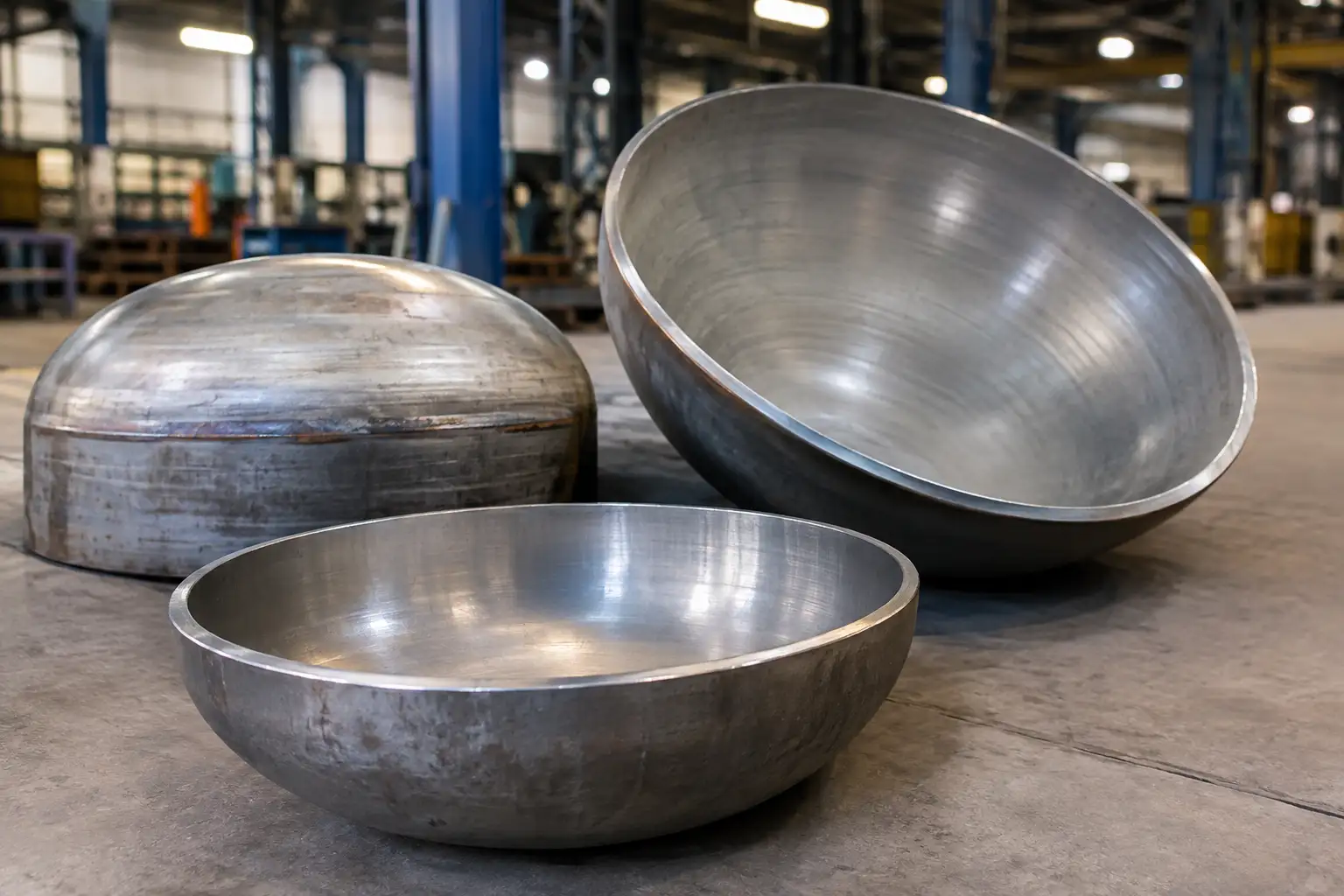
When it comes to manufacturing an industrial vessel, pressure vessel, storage tank, or process equipment, the main focus is usually placed on the shell, plate thickness, and auxiliary systems. However, one of the most important components of this equipment, which has a direct impact on its mechanical performance and final quality, is the vessel head.
In fact, a head is a formed component installed at the ends of vessels and industrial equipment. Depending on its design, it can play an important role in pressure resistance, stress distribution, sealing, connection to the shell, and the overall performance of the equipment. Therefore, the selection and manufacturing of a vessel head should not be based solely on diameter and plate thickness. Factors such as head type, material, design pressure and temperature, operating conditions, manufacturing standards, forming method, dimensional tolerances, and quality-control requirements must all be considered together.
In this article from Sadra Sanat Rad, we examine one of the company’s services: manufacturing various types of heads for pressure vessels and storage tanks. We will explain, in simple but technically accurate terms, what a vessel head is, what types are available, what the differences are between Torispherical, Elliptical, and Dome heads, how they are manufactured, which standards are important in their production, and what should be considered when ordering an industrial vessel head.
فهرست مطالب
ToggleWhat Is a Vessel Head?
A vessel head, also known as a Pressure Vessel Head / Tank Head, is a formed metal component used to close the end of a vessel.
Contrary to what some people may assume, a vessel head is not a flat plate. A head has a curved surface, and this curvature allows the equipment to distribute forces resulting from pressure differently and, in many applications, more effectively throughout its structure.
Vessel heads are used in various types of equipment, including:
- Pressure vessels
- Storage tanks
- Industrial tanks
- Process equipment
- Heat exchangers
- Separators
- Reactors
- Steel industry equipment
- Oil, gas, and petrochemical equipment
- Certain food and chemical industry equipment
Therefore, when we discuss different types of pressure vessel and storage tank heads, we are not simply talking about an ordinary piece of metal; we are discussing an engineered component of industrial equipment.
Why Is the Vessel Head Important in Tank Manufacturing?
To better understand the importance of a vessel head, consider a simple example. Imagine that the end of a cylindrical vessel is closed using a completely flat plate. In this case, the flat plate must withstand the forces resulting from pressure. To achieve the required pressure resistance, greater thickness or additional reinforcement may be required, which can significantly increase costs.
Now imagine replacing the flat plate with a curved surface that has different mechanical behavior and can distribute forces through the structure more effectively and with lower stress concentrations. However, not every head is suitable for every vessel. The geometry of the head must be appropriate for the operating conditions, design, and manufacturing requirements.
In the design of a pressure vessel, factors such as internal pressure, external pressure, design temperature, diameter, material, thickness, corrosion allowance, weld joint efficiency, and the applicable design code must be considered together with the head geometry. Therefore, manufacturing an industrial vessel head should be considered part of the engineering and manufacturing process of the vessel, rather than simply a sheet-metal forming operation.
What Are the Main Types of Pressure Vessel and Storage Tank Heads?
Vessel heads can be classified into different categories based on their geometry. However, three important types that are widely used in industrial applications are:
- Torispherical Head
- Elliptical / Ellipsoidal Head
- Dome / Hemispherical Head
Each type has its own characteristics, and the appropriate selection depends on the project requirements.
1. What Is a Torispherical Head?
A Torispherical Head, also known as a torispherical or toric head, is one of the commonly used head types in the manufacturing of vessels and industrial equipment.
The geometry of this head consists of a main curved surface and a transition area near the connection to the shell.
Two important parameters in this geometry are:
- Crown Radius
- Knuckle Radius
The Crown Radius is the radius of the main or crown portion of the head, while the Knuckle Radius is the radius of the transition area between the curved portion of the head and the shell connection. This transition area allows the head geometry to connect to the cylindrical shell of the vessel in a controlled manner.
Applications of Torispherical Heads
Torispherical heads are used in a wide range of industrial equipment, including:
- Industrial vessels
- Pressure vessels
- Process equipment
- Industrial tanks
- Certain oil and gas equipment
- Petrochemical equipment
- Steel industry equipment
The exact application, however, must be evaluated and determined according to the applicable design code and the service conditions of the equipment.
Advantages of Torispherical Heads
One of the reasons Torispherical Heads are widely used is their ability to provide a balance between mechanical performance, manufacturability, and lower cost in many projects.
Some of their characteristics include:
- Suitable geometry for many industrial applications
- Manufacturability in various dimensions
- Compatibility with a wide range of materials
- Ability to be welded to the vessel shell
- Wide application in process equipment
- Manufacturing according to project drawings and technical specifications
However, these advantages should not be considered universal for every project. For example, the fact that a Torispherical Head has performed well in one vessel does not mean that it can be used for another vessel without performing the required calculations.
2. What Is an Elliptical or Ellipsoidal Head?
An Elliptical Head, also known as an Ellipsoidal Head, is another widely used type of head for pressure vessels and industrial equipment.
Elliptical means oval-shaped, and as the name suggests, the geometry of this type of head is based on an elliptical shape. One of the best-known geometries in this category is the 2:1 Ellipsoidal Head.
In this geometry, there is a defined relationship between the diameter and the depth of the head. The final geometry must be determined according to the project drawing and applicable design code. Because of its elliptical shape, it can be a suitable option for many vessels and pressure-containing equipment.
What Is a 2:1 Ellipsoidal Head?
When the industry refers to a 2:1 Ellipsoidal Head, it generally means an ellipsoidal head with a specific geometric relationship between its diameter and depth. In an idealized geometry, the internal depth of the head is approximately equal to half of the internal radius, or one-quarter of the internal diameter.
However, in actual manufacturing, tolerances, thickness, forming method, springback, radii, and manufacturing drawing requirements must also be considered.
Therefore, a “2:1 head” should not be interpreted simply as manufacturing a component with a basic 2-to-1 ratio. It is an engineered geometry that must be evaluated within the design framework of the equipment.
Advantages of Elliptical Heads
Elliptical Heads are widely considered in industrial projects because of their geometry and mechanical characteristics.
Their main characteristics include:
- Suitable for many pressure-containing equipment applications
- Appropriate force distribution across the curved surface
- Suitable for industrial vessels
- Manufacturability in different dimensions and thicknesses
- Manufacturing from carbon steel, stainless steel, and certain alloy materials
- Production according to project drawings and technical specifications
3. What Is a Dome or Hemispherical Head?
A Dome Head or hemispherical head has a geometry close to a spherical surface. In an ideal spherical shell, pressure-induced forces can be distributed effectively across the curved surface, which is why spherical and hemispherical geometries are mechanically important.
Dome Heads are generally considered for projects where the pressure conditions, geometry, available space, and design requirements allow their use. These heads can be used when a spherical geometry is appropriate for the equipment design.
Below, we compare Torispherical, Elliptical, and Dome heads.
Comparison of Torispherical, Elliptical, and Dome Heads
| Feature | Torispherical | Elliptical | Dome |
|---|---|---|---|
| Geometric shape | Combination of spherical and toroidal surfaces | Elliptical | Spherical |
| Pressure resistance | Good | Very good | Very good |
| Head depth | Medium | High | High |
| Required thickness | Generally greater than Elliptical | More efficient for pressure applications | Depends on design and application |
| Manufacturing cost | Medium | Medium to high | High |
| Main application | General industrial vessels and equipment | Pressure vessels | Specialized applications and industrial equipment |
| Main advantage | Relatively economical manufacturing and wide application | Good strength-to-weight ratio | Good resistance and uniform stress distribution |
| Limitation | May require greater thickness at higher pressures | More precise manufacturing process | More complex forming and manufacturing |
The table above is only an initial comparison. None of these three types can be considered the “best head” for every vessel without evaluating the actual design conditions.
What Is the Best Type of Head for a Pressure Vessel?
This is one of the most common questions asked by buyers and even by people who are entering the industrial equipment field for the first time.
The answer is simple:
There is no single best type of vessel head; there is a most suitable head for each project.
The head should be selected according to the project and based on parameters such as:
- Design pressure
- Design temperature
- Vessel diameter
- Thickness
- Material
- Fluid type
- Corrosion conditions
- External pressure
- Vacuum conditions
- Connection type
- Design standard
- Manufacturing requirements
- Production method
Therefore, if you intend to order a vessel head, providing the project drawing and technical specifications can make the evaluation process much more accurate.
Technical Specifications for Vessel Head Manufacturing
At Sadra Sanat Rad, industrial vessel heads are manufactured according to project and customer requirements. The production ranges available for common customer orders include the following:
| Technical Specification | Value / Description |
|---|---|
| Head type | Torispherical, Elliptical, and Dome |
| Head diameter | 750 to 3000 mm |
| Plate thickness | 3 to 15 mm |
| Carbon steel | A516 Gr. 60 / 70 |
| Stainless steel | Stainless Steel 304 / 316 |
| Alloy steel | According to service conditions and project specifications |
| Design and manufacturing standards | ASME Section VIII Div. 1, DIN 28011 / DIN 28013 |
| Edge preparation | V-Bevel and U-Bevel |
| Quality control tests | PT and UT according to project requirements |
| Material documentation | MTC (Material Test Certificate) |
| Manufacturing tolerances | According to the applicable standard and approved project drawing |
| Service conditions | Based on pressure, temperature, fluid, and design requirements |
These figures are intended for preliminary inquiries and common orders, while the final specifications must be reviewed and determined based on the project drawing, material, and design conditions.
Manufacturing Heads with Diameters from 750 to 3000 mm
One of the most important parameters in vessel head manufacturing is diameter. In industrial projects, the head diameter is determined based on specific criteria such as:
- Internal diameter of the vessel
- External diameter of the vessel
- Connection type
- Shell thickness
- Project standard
At Sadra Sanat Rad, vessel heads can be reviewed and manufactured within the 750 to 3000 mm diameter range for common orders. Before production, our team verifies whether the specified diameter refers to the Inside Diameter or Outside Diameter, because this seemingly simple detail can affect the final dimensions, shell connection, and assembly in large-scale projects.
Materials Used for Vessel Head Manufacturing
Material selection is one of the most important parts of an industrial vessel head order. Sadra Sanat Rad can manufacture heads, depending on project specifications, using materials such as:
A516 Gr. 60 Carbon Steel
A well-known and widely used carbon steel grade for pressure vessels and pressure-containing equipment.
A516 Gr. 70 Carbon Steel
Another widely recognized material grade used in pressure equipment and many industrial projects.
Stainless Steel 304
When corrosion resistance and specific material properties are important, Stainless Steel 304 can be considered depending on the service conditions.
Stainless Steel 316
For environments where higher corrosion resistance is important, Stainless Steel 316 can be a suitable option depending on the service conditions.
Alloy Steels
For projects where temperature, pressure, or operating environment requires a specific material, alloy steels should also be evaluated. The final material selection must be based on the service conditions and engineering specifications of the project.
Vessel Head Manufacturing Standards
Different projects may require different standards, and vessel heads are designed and manufactured according to the applicable project standards.
Relevant standards in this field include:
- ASME Section VIII
- DIN 28011
- DIN 28013
The manufacturing standard must be selected according to the equipment type, application, and project requirements. For example, ASME Section VIII applies to pressure equipment, while the relevant DIN standards may provide specific geometric and manufacturing requirements for different types of vessel heads.
Therefore, the phrase “manufactured according to standards” has real value only when the exact standard, applicable edition, and project-specific requirements are clearly defined.
How Is a Vessel Head Manufactured?
Manufacturing a vessel head is a multi-stage process that starts with reviewing the technical specifications and ends with quality control of the finished product.
The details of the process depend on the head type, material, thickness, diameter, and project requirements.
Below are the main stages of vessel head manufacturing.
Stage One: Reviewing the Drawing and Technical Specifications
Before each project, the project information is reviewed.
This information may include:
- Head type
- Diameter
- Thickness
- Material
- Standard
- Depth
- Connection requirements
- Weld type
- Inspection requirements
If the project includes a manufacturing drawing, reviewing that drawing is the most appropriate approach.
Stage Two: Material Selection and Inspection
After selecting the material, the appropriate plate is procured and inspected. In industrial projects, the issue is not simply the type of steel. The technical specifications of the plate, grade, thickness, and relevant material documentation are also important.
Stage Three: Plate Cutting
The initial plate must be cut according to the required pattern. Accuracy at this stage is highly important because the dimensions of the blank directly affect the forming process and the final dimensions of the head.
Stage Four: Head Forming
The most important part of the manufacturing process is transforming the flat plate into the required geometry. The forming method depends on several factors, including thickness, material, diameter, and geometry.
During this stage, the plate is formed into one of the following geometries:
- Torispherical
- Elliptical
- Dome
If the final shape of the head does not conform to the drawing, problems may occur during assembly and connection to the shell. For example, variations in depth, diameter, crown radius, thickness, and other dimensions can affect the fit of the component to the shell. Therefore, geometric inspection is one of the main parts of vessel head quality control.
Quality Control of Vessel Heads
An industrial vessel head can only be considered reliable when, in addition to having the correct shape, its manufacturing quality has also been properly controlled.
Depending on project requirements, quality control may include:
- Visual inspection
- Dimensional inspection
- Thickness inspection
- Material verification
- Edge inspection
- Non-destructive testing
- Quality documentation
Below are some of the tests used for this purpose.
What Is PT Testing?
PT or Liquid Penetrant Testing is a non-destructive testing method used to identify certain surface-breaking discontinuities. It is particularly suitable for detecting cracks and other surface defects when PT is applicable to the material and geometry being inspected.
In projects where the customer requires specific inspection or documentation, PT can be included as part of the quality control program.
What Is UT Testing?
UT or Ultrasonic Testing is another non-destructive testing method that uses ultrasonic waves to inspect certain internal defects or measure thickness.
The use of UT must also be defined according to the material type, component geometry, thickness, and project requirements.
What Is an MTC?
In industrial projects, material traceability is highly important. An MTC or Material Test Certificate is a document providing information about the material. Depending on the certificate type and applicable standard, it may contain information such as:
- Material specifications
- Chemical composition
- Mechanical properties
- Heat number
- Thickness
- Standard
Applications of Vessel Heads in the Steel Industry
The steel industry is one of the sectors where industrial equipment often operates under demanding conditions. Vessels and equipment used in this industry may be exposed to high temperatures, pressure, thermal cycles, corrosive environments, vibration, and mechanical loading. Therefore, the manufacturing quality of equipment components, including vessel heads, is particularly important.
Vessel heads are also used in various industries, including oil, gas and petrochemical, food processing, chemical, and process industries.
Sadra Sanat Rad, with a focus on manufacturing industrial equipment used in various industries, also manufactures industrial vessel heads according to project requirements and available production capabilities.
Manufacturing Various Vessel Heads at Sadra Sanat Rad
Sadra Sanat Rad operates in the field of manufacturing industrial equipment used in the steel industry. One of the company’s service areas is the manufacturing and production of various vessel heads for pressure, storage, and process equipment applications.
The company can review and manufacture various types of:
- Torispherical Heads
- Elliptical Heads
- Ellipsoidal Heads
- Dome Heads
- Pressure Vessel Heads
- Industrial Tank Heads
- Process Equipment Heads
- Heads used in steel industry equipment
The production range available for common orders includes diameters from 750 to 3000 mm and thicknesses from 3 to 15 mm.
Manufacturing with materials such as A516 Gr. 60, A516 Gr. 70, Stainless Steel 304, Stainless Steel 316, and certain alloy materials can also be evaluated according to project requirements.
Conclusion: Vessel Head Selection and Manufacturing Is an Engineering Process
Pressure vessel and storage tank heads are available in different geometries. Among them, Torispherical, Elliptical, and Dome heads are important types used in industrial equipment. Each of these heads has its own geometric characteristics, applications, and design requirements, and no single type can be considered the best option for every vessel.
Frequently Asked Questions About Vessel Head Manufacturing
What Is a Vessel Head?
A vessel head is a formed metal component used to close the ends of vessels, pressure equipment, and certain process equipment.
What Are the Main Types of Vessel Heads?
Important types include Torispherical, Elliptical / Ellipsoidal, and Dome heads.
What Is the Difference Between a Torispherical and an Elliptical Head?
A Torispherical Head has a crown section and a knuckle region, while an Elliptical Head is based on an elliptical geometry. The difference in geometry can affect mechanical performance, depth, thickness, and the manufacturing process.
What Is a 2:1 Ellipsoidal Head?
A 2:1 head generally refers to an Ellipsoidal Head with a specific geometric relationship between its diameter and depth. The final details must be determined according to the project drawing and applicable design code.
What Types of Vessels Are Dome Heads Used For?
A Dome Head or hemispherical head can be used in equipment where a dome-shaped or near-spherical geometry is compatible with the design conditions.
What Types of Vessel Heads Does Sadra Sanat Rad Manufacture?
Sadra Sanat Rad manufactures Torispherical, Elliptical / Ellipsoidal, and Dome heads for vessels, tanks, and industrial equipment.
What Is the Manufacturing Diameter Range of Vessel Heads at Sadra Sanat Rad?
The available range for common orders is 750 to 3000 mm. Final manufacturing capability must be evaluated according to the drawing, production equipment, and project specifications.
What Thickness Range Can Be Manufactured?
The specified range for common orders is 3 to 15 mm.
What Materials Can Be Used to Manufacture Vessel Heads?
Depending on project specifications, materials such as A516 Gr. 60, A516 Gr. 70, Stainless Steel 304, Stainless Steel 316, and certain alloy steels can be considered.
Does Sadra Sanat Rad Provide Edge Preparation?
Yes. Depending on project requirements, edge preparation methods such as V-Bevel and U-Bevel can be provided.
Are UT and PT Testing Available?
When requested and according to project requirements, UT and PT can be considered and performed.
Is an MTC Provided with the Vessel Head?
When requested by the customer and according to the order specifications, a Material Test Certificate or MTC can be provided with the product.
What Information Is Required for a Vessel Head Price Inquiry?
For an accurate quotation, it is recommended to provide the head type, internal or external diameter, thickness, material, quantity, applicable standard, manufacturing drawing, and quality-control requirements such as PT, UT, and MTC.
How Much Does a Vessel Head Cost?
The price depends on factors such as head type, diameter, thickness, material, weight, manufacturing method, Edge Preparation, non-destructive testing, and required technical documentation. Therefore, the exact price can be determined after reviewing the project specifications.
Contact Us for Vessel Head Manufacturing
If you are looking for pressure vessel and storage tank head manufacturing according to the required dimensions and project specifications, you can send your technical specifications or manufacturing drawing to Sadra Sanat Rad. Our technical team is ready to review orders for Torispherical, Elliptical / Ellipsoidal, and Dome heads and provide a solution appropriate to your project requirements.
Sadra Sanat Rad — Manufacturing industrial equipment and vessel heads for industrial and steel industry projects.
